

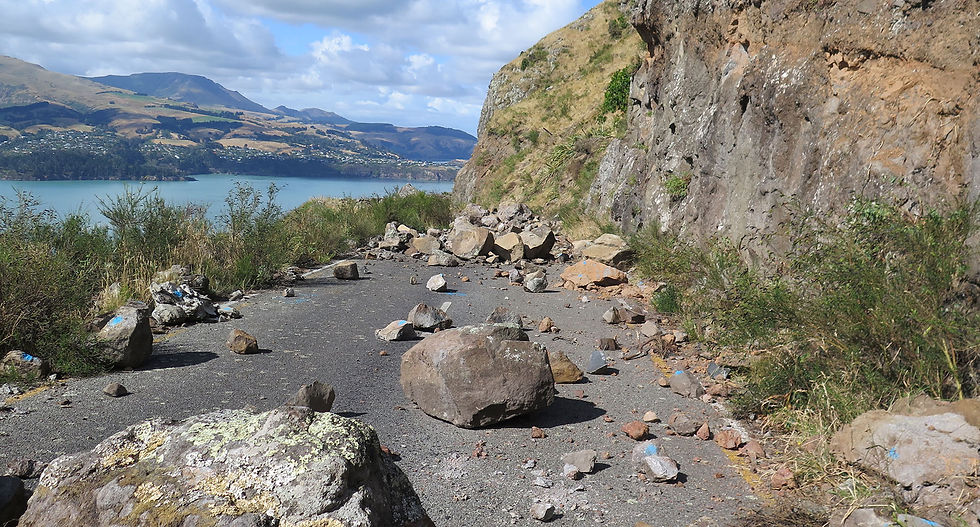
The increasing frequency of extreme weather events and ongoing infrastructure development in challenging terrain has made the implementation of rockfall systems more important than ever. From safeguarding transport corridors and dam infrastructure to protecting urban developments in steep terrain, these engineering solutions ensure public safety and infrastructure resilience. This article explores various rockfall mitigation systems, drawing on Geovert case studies and experience from across the globe.
The Science of Rockfall Assessment
A geotechnical assessment forms the foundation of any effective rockfall protection strategy. Engineers must consider the complex interplay of rock mass characteristics, slope geometry, and potential failure mechanisms. Climate conditions and weathering processes play a vital role in these assessments, as they can accelerate deterioration and trigger rockfall events. Understanding potential impact energies and trajectories through modelling enables engineers to design systems able to manage these natural hazards.
The groundbreaking rockfall modelling study in Christchurch, New Zealand, conducted by Geovert for the Canterbury Earthquake Recovery Authority (CERA), revolutionised this approach by combining high-resolution terrain data with advanced trajectory analysis. This comprehensive study established new benchmarks for risk assessment methodology, demonstrating how detailed 3D modelling can predict rockfall behaviour with unprecedented accuracy. The insights gained from this study continue to influence how engineers analyse historical rockfall patterns, geological structure, and rock mass quality to predict future behaviour.
What an Effective Rockfall Mitigation System Needs to Achieve
An effective rockfall mitigation system is defined not by the type of product installed, but by how well it manages risk across the full range of site conditions.
At a minimum, an effective system needs to achieve the following:
Reduce risk to people, infrastructure, and operations by intercepting, controlling, or containing falling rock before it reaches defined exposure zones.
Perform reliably across expected rockfall scenarios, including variation in block size, trajectory, velocity, and event frequency.
Dissipate or contain kinetic energy in a controlled manner without catastrophic failure, maintaining system integrity after impact.
Be matched to site-specific hazard conditions, informed by appropriate assessment, modelling, and engineering judgement.
Provide durability and maintainability over the design life, allowing for inspection, repair, and replacement where required.
Integrate with broader slope stabilisation measures where necessary, rather than relying on a single intervention in isolation.
In practice, effectiveness is achieved through a combination of appropriate system selection, constructibility, and long-term performance - not simply the installation of individual protection elements.
Rockfall Mitigation and Protection Solutions
ROCK SCALING
Rock scaling & Block Removal represents a fundamental approach to Rockfall Protection, serving as an essential first step in protection strategies. This controlled removal of loose or unstable rock material prevents future rockfall events by addressing hazards at their source. Experienced scalers use both manual and mechanical methods to systematically assess and remove potential hazards. Scaled material is removed in a controlled manner to prevent damage to infrastructure below, often utilising specialised equipment such as air bags and hydraulic splitters for larger blocks. This methodical process not only creates more stable slope faces but also provides useful insights into the rock mass structure that inform subsequent protection measures.
MESH SYSTEMS - Active & Passive Protection
Rockfall protection mesh systems provide two distinct approaches to Slope Stabilisation. Passive systems, such as draped mesh, control the descent of falling rock material by guiding it to a controlled collection point at the slope base. These systems typically utilise high-tensile steel wire mesh installed to conform to the slope surface. Active systems, by contrast, are tensioned against the rock face to prevent material from becoming dislodged and generating kinetic energy, often working in conjunction with rock bolts or anchor systems to provide integrated stabilisation.

ROCKFALL BARRIERS – High-Energy Impact Protection
Rockfall barriers consist of steel posts, support cables, high-tensile steel nets, and energy-dissipating brake elements working together to intercept and stop falling rocks. The barriers can be designed as both permanent installations for long-term protection or temporary systems during construction and remediation work. In an effective mitigation system, these barriers and systems can absorb massive impact forces while remaining functional, with many designs allowing for multiple impacts before requiring maintenance.
A useful example is the geohazard mitigation project in Kern, California, where Geovert was engaged to protect dam infrastructure through the installation of a 10,000kJ Geobrugg rockfall barrier system. The system combined high-tensile steel nets with energy-dissipating elements, providing exceptional protection while remaining fully maintainable. Its design allows for standard impacts to be absorbed within the elastic range, while any components affected, and plastically deformed, by major events can be individually replaced. This approach ensures long-term protection of the infrastructure while offering practical maintenance solutions for the asset owners.
ATTENUATOR SYSTEMS – Dynamic Rock Control
Attenuator systems are distinct from traditional barriers in their ability to control and dissipate the energy and bounce height of falling rocks along their descent path. The Diana Falls project in New Zealand showcases the capabilities of these systems. Following a 52,000 cubic yard slip that closed State Highway 6, Geovert implemented a complex rockfall protection solution.
The system centred on a combination of three rockfall barrier attenuators complemented by a 38-ton high tensile steel ring net drape installed 220ft above the road. Despite challenging winter construction conditions in an active rockfall zone, the innovative installations proved highly effective in managing repeated rockfall events. The success of this project, validated through controlled blast testing, demonstrates how modern mesh and attenuator solutions can be used to effectively provide reliable protection even in the most demanding geological and environmental conditions.
ROCK BOLTS & ANCHORING SYSTEMS
Rock bolt installations provide essential structural support by reinforcing the inherent strength of rock masses. These engineering solutions prevent block displacement through calculated placement and installation techniques. When integrated with mesh systems, rock bolts create a support network that addresses both surface and deep-seated stability concerns. Modern rock bolt systems incorporate corrosion protection and can be equipped with load monitoring capabilities for long-term performance verification. This technology proves particularly valuable in aggressive environments where long-term durability is essential.
Future Developments in Rockfall Mitigation
The field of rockfall mitigation continues to evolve through technological innovation and improved understanding of geological processes. Following on from the Geovert led CERA 3D rockfall modelling study, advanced modelling software now enables increasingly sophisticated trajectory analysis, leading to optimised protection system designs.
These computational advances, combined with machine learning algorithms, allow engineers to simulate thousands of potential rockfall scenarios with unprecedented accuracy. Smart monitoring systems provide early warning capabilities, while innovative materials push the boundaries of energy absorption capacity. These developments, built upon foundational studies like CERA's, promise even more effective and efficient rockfall protection solutions in the future.
Integrated Rockfall Protection Strategies

The 2016 Kaikoura earthquake in New Zealand represents one of the most significant examples of rockfall protection implementation in recent history. The earthquake, which generated the strongest ground acceleration ever recorded in New Zealand, caused catastrophic damage to critical infrastructure. The event deposited approximately 1.3 million cubic yards of rock and material onto the coastal transport corridor, severing both State Highway 1 (SH1) and the Main North Line railway between Picton and Christchurch. This devastation isolated Kaikoura and surrounding rural communities, with the closure of roads and rail networks creating an annual GDP impact exceeding $500 million.
Geovert was first on ground to begin immediate stabilisation work, and our role quickly expanded beyond specialist construction to include leading the solution identification process for the North Canterbury Transport Infrastructure Recovery (NCTIR) alliance, established by the New Zealand central government. As the specialist contractor, Geovert implemented a suite of solutions along the affected coastal corridor.
The project showcased the integration of various techniques including slope remediation design, ground anchors, Soil Nails, self-drilling anchors, and multiple types of rockfall protection systems. High-tensile slope stabilisation mesh worked in conjunction with rockfall and debris flow barriers to create protection zones. The scale of the project required international supply chain management to ensure timely delivery of specialised materials. This multi-faceted approach not only addressed immediate safety concerns but also established rockfall mitigation practices for future projects of similar complexity.
Building Resilience Through Expert Protection
Ultimately, the effectiveness of a rockfall mitigation system is measured by its ability to reduce risk in a predictable, durable, and maintainable way, balancing safety, constructibility, and long-term performance in response to site-specific hazards.
The success stories from Diana Falls, Kaikoura, and Kern County amongst others, demonstrate that while each site presents unique challenges, a systematic approach to rockfall mitigation can provide reliable protection for infrastructure and human life.
For communities and organisations facing rockfall hazards, the key lies in engaging experienced geotechnical professionals who can develop protection strategies tailored to specific site conditions. Through assessment, design, and implementation of appropriate systems, the risks associated with rockfall can be effectively managed.