

What Good Looks Like: Design Build Highwall Stabilisation
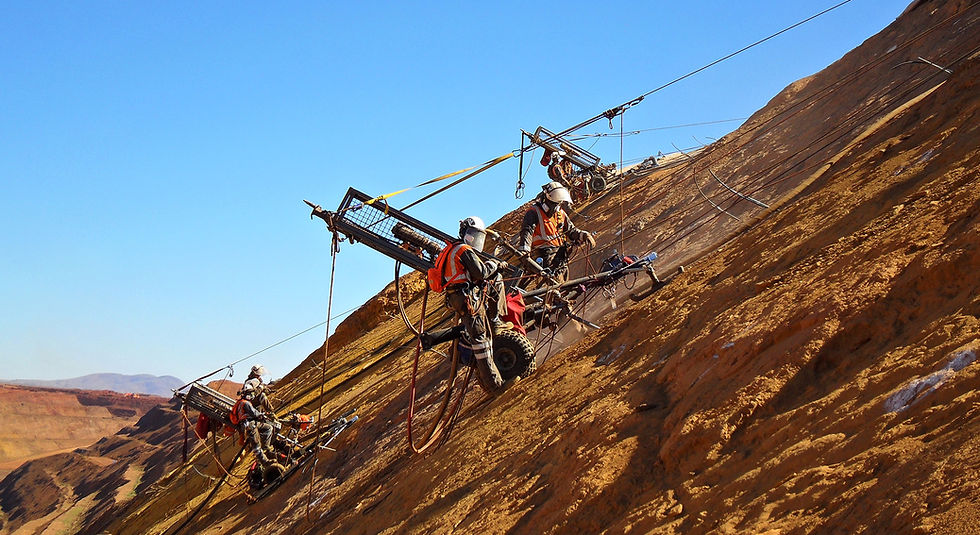
A multiple bench scale instability at Rio Tinto's West Angelas iron ore mine blocked access to high-grade ore below. Geovert's design-build approach used top-down rope access construction to install an anchored mesh system to safely stabilise the highwall.
In our 'What Good Looks Like Series' we're examining what good looks like across the different types of work we do, from emergency response slope stabilisation and mining ground support to geohazard mitigation and asset integrity maintenance. These aren't showcases of perfect projects with ideal conditions. They look at real work where solutions had to adapt as conditions changed, where collaboration shaped outcomes, and where technical expertise met practical constraints.
Overview
A multiple bench scale instability at Rio Tinto’s West Angelas iron ore mine created a problem familiar to open pit operations: high-grade ore sterilised below unstable ground. Blasting or vibration from heavy machinery near the zone of instability had the potential for triggering additional movement, a concern for both the safety of personnel working in the mine and long-term stability of the pit wall. Rio Tinto understood the risks and looked to external consultants to provide input on practical solutions that would enable access to the high grade ore while ensuring the safety of all personnel and machinery working in the area.
The Problem
Following a highwall instability event, a significant amount of fractured material was undercut and left hanging approximately 150m above the pit floor. The geology in the area consisted primarily of Banded Iron Formation (BIF) with the instability occurring along a shale bedding plane that dipped at approx. 40 degrees. Drill and blast works were able to reduce part of the overhang however a 0.75m rock layer remained which posed a risk to personnel working below.
An Access Issue
One of the major project constraints was access with traditional ground-based equipment not having the ability to operate on a steep highwall and mid-slope rockfall barrier construction would have required workers to access the area under known unstable ground. Rio Tinto, in collaboration with Geovert resolved that the safest methodology was top-down ground support installation using rope access and lightweight drilling equipment. This approach allowed crews to work directly on the slope face while minimising exposure to unstable ground and avoiding the need for large scale earthworks or heavy access infrastructure, an important milestone for Rio Tinto who had previously banned rope access works on iron ore sites.

The Solution: Anchored High-Tensile Mesh
The selected solution involved the installation of a pre-tensioned anchored high tensile mesh system using Geobrugg TECCO mesh combined with rock bolts and specialised spike plates. The purpose of the system was to actively stabilise loose surficial rock and prevent failed material from falling into the pit below.
Approximately 6,000m² of high tensile mesh and 498 anchors were installed across the affected slope area. The mesh was secured using 25mm galvanised threaded bar anchors installed at approximately 3m x 3m spacing, each anchor was installed and tensioned to ensure the mesh remained tightly pinned against the face. Additional reinforcement was installed near the crest where blast damage and loosening were considered more likely.
The stabilisation design focused on controlling surficial instability rather than deep global slope failure. Engineering analysis assessed multiple potential failure mechanisms including:
Sliding of the surficial rock layer
Mesh puncturing
Local block breakout between anchors
Combined tensile and shear loading on the anchors
The system was designed so that forces generated by unstable rock would be transferred through the mesh and spike plates into the anchored bolts and ultimately into stable ground behind the failure zone.
The high tensile mesh system offered several advantages compared with more traditional rockfall mitigation approaches. The system was lightweight, flexible, fast to install and well suited to difficult access terrain. It also allowed the slope face to remain visible for future inspection and monitoring activities.

Construction and Safety Management
Quality assurance formed a key part of the project delivery. Grout samples were tested in a NATA accredited laboratory to confirm compliance with specified compressive strengths. Anchors were selected across the full extent of the project, with additional testing targeted at areas of poorer ground conditions identified by drillers during installation. Approximately 5% of all installed anchors were pull-tested to 120% of the design load to verify performance under field conditions.
Monitoring systems including TDR cables were also installed within the slope to allow ongoing deformation monitoring.
The top-down rope access methodology significantly reduced the exposure of personnel to unstable ground while also minimising disruption to ongoing mining activities. The use of lightweight specialist equipment also reduced mobilisation requirements and improved construction efficiency in the confined work area.
Proof in Practice
Several rockfall events occurred after construction, including the release of a large boulder approximately 3.5 m long, 1.5 m wide and weighing around 12 tonnes. The anchored mesh system successfully retained the fallen material without significant damage to the mesh or anchor system. This real-world performance demonstrated that the design assumptions and engineering calculations accurately reflected the actual conditions on site.
The successful retention of the boulder provided practical confirmation that the mesh, anchors and spike plate system were capable of managing the expected loading conditions. Importantly, the retained material did not impact mining operations below and no personnel or equipment were exposed to additional risk during these events.
What This Demonstrates
The project demonstrates how engineered high tensile mesh systems can provide a practical solution for managing instability risks in large open pit mining operations. Rather than attempting to eliminate all rockfall hazards, the project focused on controlling the risks sufficiently to allow mining operations to safely continue beneath the affected area.
The project also highlights the importance of combining geotechnical design with practical construction methodologies and demonstrated how anchored high tensile mesh can be an effective, economical and operationally practical solution for managing rockfall hazards in challenging open pit environments.