

Emergency Landslip Response on New Zealand's East Coast

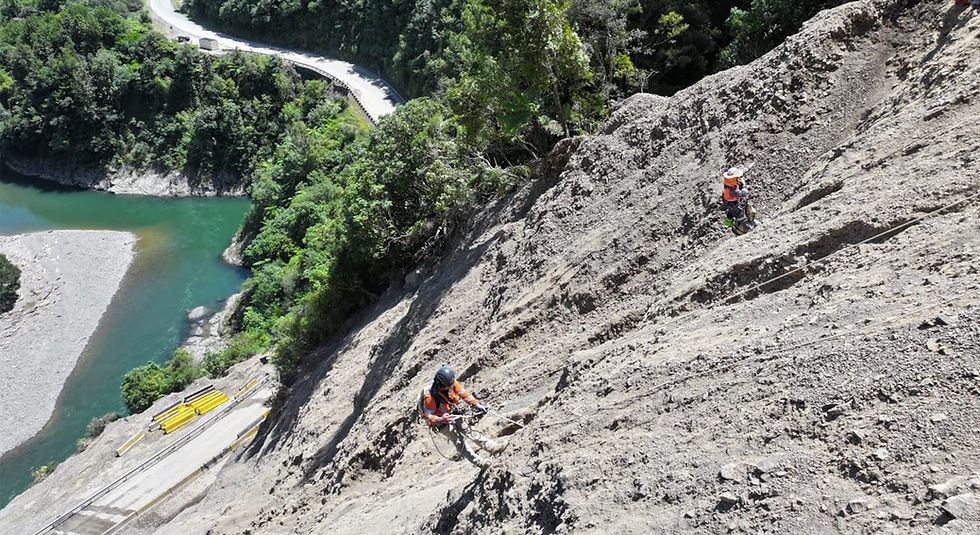
Severe weather in early 2026 caused significant landslips across the North Island, cutting off communities and closing key state highways. Geovert was engaged to provide emergency rope access scaling, beginning with a Sunday call from a project manager at Stellar Project Management requesting a team on site the following morning. David Swan, Geovert's New Zealand Operations Manager, coordinated the response and briefed team leader Ikanui Enoka, who put the call out to crews across the North Island network. The response was both immediate and impressive, with multiple crews putting their hands up to help, far more than were needed at the time.

Ika had a crew on site within five hours. A site inspection was completed that Sunday evening, safety documentation prepared, and works were underway by Monday morning. Geovert quickly became an integral part of the emergency recovery effort, contributing to decision-making and operations across SH2's Waioeka Gorge and SH35's Eastern Cape, and coordinating closely with the other contractors working across multiple sites.
Key Transport Routes at Risk
That mobilisation was the start of several weeks of emergency response work across three state highways - SH2, SH35, and SH3 - the last brought in when a second storm struck the North Island's West Coast. These routes are key arteries for the country. SH2 connects Gisborne and the Bay of Plenty, carrying primary industry freight, including kiwifruit and timber, to the Port of Tauranga. SH3, closed at the height of a fuel crisis, is the main link between Auckland and New Plymouth for freight and fuel deliveries. The available alternative routes added more than five hours of travel time and placed pressure on infrastructure not built for that volume of heavy freight. Reconnecting these communities safely and quickly mattered directly to the country's supply chains.
Assessing the Risk
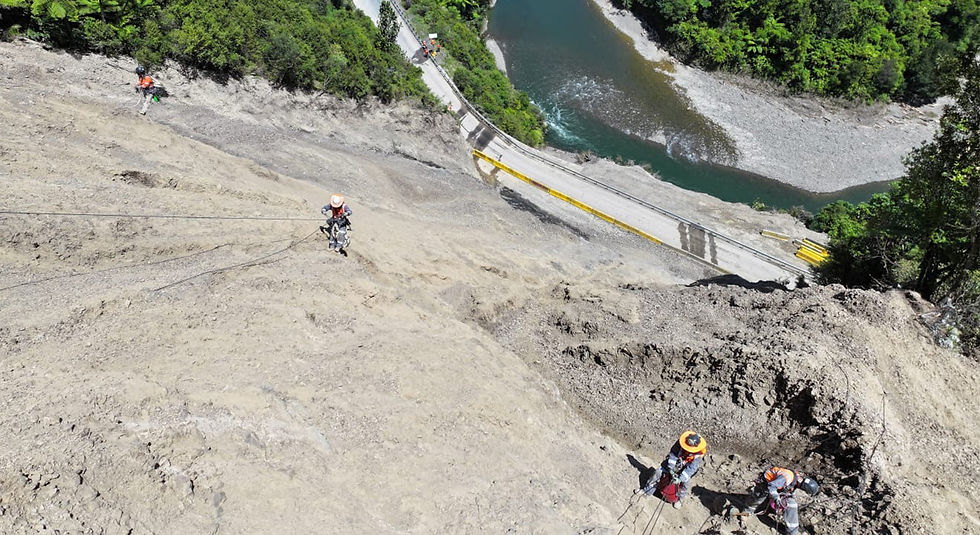
Geotechnical risk assessment and inspection of each slip preceded any physical works, with escape routes identified and rescue plans confirmed before crews descended. On ground that is steep and unstable, the approach required diagonal access lines, hand safety ropes rated for substantial gear loads and natural anchor selection for rigging under IRATA Level 3 supervision. Teams worked in synchronised descents, with Starlink and radio maintaining communications when mobile coverage wasn’t available. The geotechnical risk assessment work by our team on the ground is the foundation on which every subsequent decision rests and the calls made at this time - about what to remove, what to leave and in what order determines whether a road reopens or not.
The value of that assessment was demonstrated at the Goldsmith's slip on SH2, which extended 50 metres wide and more than 100 metres high, with over 20,000 cubic metres of earth involved, posing a substantial challenge for assessment and scaling. Geovert's crews approached and assessed the slip from the top down via an adjacent outfall, a method chosen to manage the scale of the site safely.
On SH2, the scope extended beyond the initial stabilisation work. Working with Beca and NZTA, Geovert moved into the design and installation of a drape mesh system, delivered from concept to completed installation within three weeks.
Relationships Built Over Time
When Stellar Project Management made the initial call on a Sunday, Geovert was able to respond quickly by resourcing crews from nearby projects. Stellar's Richard Dodera later reflected on the response:
"In response to significant weather-related events, Geovert mobilised rapidly and demonstrated a strong commitment to supporting the recovery effort, providing specialist geotechnical construction services across multiple sites. Their proactive, collaborative approach and ability to adapt to evolving site conditions contributed to the safe and efficient delivery of stabilisation works and the restoration of these critical transport corridors."
The speed of a mobilisation like this depends on having the right people available, but also on the relationships built with clients and partners over time. It is a mutual understanding developed through projects delivered and problems solved together.
Geovert has worked in natural hazard mitigation for 25 years, building the relationships, teams and capacity to move from a Sunday phone call to work underway by Monday morning. For David Swan, who briefed the team and stayed close to the response throughout, the weeks that followed were a reminder of what that experience looks like when it matters.


Comments